
GAS NITRIDING- IN HOUSE GAS NITRIDING FURNACES- NOT ONE- BUT BATTERY OF THEM
We are having one of the biggest gas nitriding plants in Asia. Our gas nitriding furnaces are of different depths.
What is Gas Nitriding?
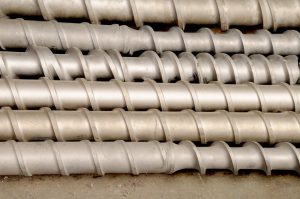 Gas Nitriding is a case hardening process in which Nascent Nitrogen is diffused into the surface of a Solid Ferrous alloy. It gives Excellent wear resistance, Hardness up to 70 Rc, i.e. 950 to 1150 VPN is possible. Screws and barrels are gas nitrided to ensure hardness and wear resistance.
Gas Nitriding is performed on finished components. It also gives Excellent corrosion resistance against humid air & water.
Gas Nitriding is a case hardening process in which Nascent Nitrogen is diffused into the surface of a Solid Ferrous alloy. It gives Excellent wear resistance, Hardness up to 70 Rc, i.e. 950 to 1150 VPN is possible. Screws and barrels are gas nitrided to ensure hardness and wear resistance.
Gas Nitriding is performed on finished components. It also gives Excellent corrosion resistance against humid air & water.
It is a case hardening process & hence core can remain tough. Gas Nitriding is done on alloy steel which contains Aluminum, Chromium, Tungsten & Molybdenum. Mo reduces the risk of embitterment at Nitriding temperature. Nickel, Copper, Silicon & Manganese do not give any advantages of Nitriding Nitriding properties. Gas Nitriding is not done on carbon steel except for corrosion resistance properties. Alloy having Aluminum gives maximum hardness & wear resistance. Hence En41B is the best material for gas nitriding (especially for screws and barrels).
Hardening & Tempering
Normalizing: A Process in which an iron-base alloy is heated to a temperature above the transformation range and subsequently cooled in still air at Room temperature. It is done to recover the original properties of the material. Annealing: in metallurgy and materials science, is a heat treatment wherein a material is altered, causing changes in its properties such as strength and hardness.
It is a process that produces conditions by heating to above the recrystallization temperature and maintaining a suitable temperature, and then cooling. Annealing is used to induce ductility, soften the material, relieve internal stresses, refine the structure by making it homogeneous, and improve cold working properties. Stress Relieving: A process to reduce internal residual stresses in a metal object by heating the object to a suitable temperature and holding for a proper time at that temperature. This treatment may be applied to relieve stresses induced by casting, quenching, normalizing, machining, cold working or welding.
Electroless Nickel Plating
Electroless nickel plating is an auto-catalytic reaction used to deposit a coating of nickel on a substrate. Unlike electroplating, it is not necessary to pass an electric current through the solution to form a deposit. This plating technique is to prevent corrosion and wear.
EN techniques can also be used to manufacture composite Coatings by suspending powder in the bath. Electroless nickel plating has several advantages versus electroplating. Free from flux-density and power supply issues, it provides an even deposit regardless of Workpiece geometry, and with the proper pre-plate catalyst, can deposit on non-conductive surfaces.